|
 |
Skiing Fitness Program
Skiing for most people is in the form of a 7 day skiing holiday once a year in the pursuit of good snow. Time should be given prior to your skiing holiday to concentrate on your fitness in order to get the full benefits from only a short period on the snow.
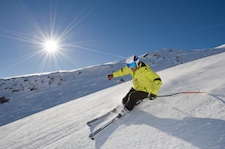
Fortunately with modern equipment and ski instruction at dry ski schools, serious injuries are reducing in number, however overuse injuries and muscle soreness prevent many people from improving their skiing.
Look at commencing your skiing fitness program a minimum of 8 weeks prior to your time on the slope.
Focus on, muscular strength and endurance, especially in the muscles in the legs, especially your quadriceps (thigh muscles).
Flexibility, and a well structured stretching program will assist in a good range of movement in your joints and enable your body to get used to the sudden stretching movements that a good ski run will place on you.
Aerobic training will enable you to ski longer and test out more of what any good ski resort can offer, as fatigue results in poor concentration ending in injury from falling and crashing.
Most injuries occur in the afternoon of the first two days, this can workout to be an expensive skiing holiday. Use the following skiing fitness exercises, to hopefully aid you, to enjoy your time on the ski slopes.
The following lower body circuit is designed to be used with the combination of various gym machines, if you don't have access to a gym, then look at the home exercises section for suitable lower body workouts.

|
LEVEL
|
SET 1
|
SET 2
|
SET 3
|
SET 4
|
|
REPS
|
REST
|
REPS
|
REST
|
REPS
|
REST
|
REPS
|
REST
|
|
INTER - MEDIATE
|
12-15
|
30 SEC
|
10-15
|
30 SEC
|
-
|
-
|
-
|
-
|
|
ADVANCED
|
15-20
|
20 SEC
|
15-20
|
20 SEC
|
12-15
|
20 SEC
|
|
|
|
ATHLETIC
|
20-25
|
10 SEC
|
20-25
|
10 SEC
|
15 -20
|
15 SEC
|
15-20
|
15 SEC
|
|
WARM UP AND STRETCH
PRIOR TO DOING THIS CIRCUIT
|
|
Ski
Jumps - Aim to stay in a
squatted position whilst jumping first 90 degrees to the left, then back to
the centre, then 90 degrees to the right, finishing back at the centre, this
will be one repetition. This exercise is very hard and you may wish to
reduce the amount of reps by as much as 50%. As you get adapted to the
exercise, you can increase the amount of reps that you perform. |
|
Machine
Squat - Avoid locking your legs out
throughout the exercise, and also lowering yourself down below a 90 degree angle at your knee. If accustomed to weights, try and change your foot
position so that your feet face outwards on some of the sets. |
|
Rear
Leg Raised Lunge - Rest one
foot on a raised platform, with your laces facing downwards. Keep your
knee in line with the toes on the other foot, lower yourself down, keeping
your back straight. Made harder if holding weights, or if working on a non-secure platform such as a Bosu or Swiss Ball. |
|
Step Box Jump onto a
secure platform taking off and landing on both feet. Use your arms for
balance and gaining height. The fitter and more confident you become with
this exercise, the further you will be able to jump onto the box, and also
to the side. This is a very hard exercise, and as such you may want to
reduce the repetitions by 50%. |
|
Seated
Leg Extension - Avoid locking the
legs out, perform in a smooth motion keeping your back firmly in the seat.
You may wish to work one leg at a time, if you do this, make sure you use
a suitable weight. |
|
Abductor
Machine ,
use a suitable weight, aiming to hold the legs wide for 2 - 3 seconds before
lowering under control and repeating.
You should always warm the inner and outer thigh muscles prior to performing this exercises, giving them a good stretch to avoid any injury. |
|
Pulsing
Squat - Perform in small
movements, stay in a squatted position and pulse for 3 pulses intermediates,
4 pulses advanced and 5 pulses athletic. The exercise can be made harder
by using a suitable weight. Remember to come up fully after each set of
pulsing, as this will help prevent your legs from becoming totally lactic.
|
|
Hamstring
Curl Machine. Use a suitable weight and perform smooth reps. Avoid pushing
yourself on this exercise, as most people's hamstrings will tend to be
tight, and can easily be damaged. |
|
1
Leg Squat Place one foot
on a secure platform, keeping the other leg at the side. Lower yourself
down, whilst holding onto a chair or wall for support. Avoid going lower
than 90 degrees and taking your knee over your toes. Made harder with weights.
If you have no platform, keep one knee a few inches higher than the other leg, lowering down under control, to keep that foot off the floor. |
|
Adductor
Machine,
use a suitable weight, aiming to hold the legs together for 2 - 3 seconds
before relaxing under control and repeating.
You should always warm the inner and outer thigh muscles prior to performing this exercises, giving them a good stretch to avoid any injury. |
|
Standing Squat. Using a suitable
weight, either barbell or dumbbell, lower yourself down, with a straight
back, no lower than 90 degrees. Aim to work with your feet in various positions,
try feet together, feet wide, feet facing in and feet facing out.
If using a barbell across your neck, wrap a towel around the bar to protect yourself.
|
|
Raised Squat. Place one foot on a raised secure platform, with your other
foot out to your side on the floor. Keeping your back straight lower downwards,
avoiding taking your knees over your toes. Repeat the reps both sides. |
Aim to do these exercises twice a week, with at least 2 days rest between sessions. The main muscles used during skiing are those of your quadriceps (thighs), however a total body workout needs to be done, as all of your muscles will be used, and as soon as one of them becomes tired, your skiing ability will suffer.
The use of a Swiss Ball will certainly improve your core strength, whilst aiding your stabilty and balance on the slopes, there are over 200 different abdominal exercises and specific training programs for all levels on the Swiss Ball within our members area.
Performing aerobic exercises to improve your fitness will reduce your risk of injury, as you will be able to maintain and focus upon your skiing technique. Look at designing yourself a simple circuit, whereby you will do a 30 - 45 seconds light jog / run, followed by 8 -15 of each exercise in a controlled manner.
On your first time around perform just the leg circuit, then the leg and upper body and finally all 3 exercises. Make sure that you do the lap jog / run after each leg / upper body or abdominal circuit.
|
LEG CIRCUIT
|

|
 |

|
Two footed squat thrusts - aim for a 12 inch jump. |
Walking lunge forward - changing lead leg. |
Alternate leg squat thrusts - count reps on 1 leg only. |
|
UPPER BODY CIRCUIT
|
 |
|
 |
Wide arm press-up. Take elbows out to your sides. |
Normal press ups, aim to keep a straight line through your back. |
Close Hand - Aim to keep your thumbs touching each other. |
|
ABDOMINAL CIRCUIT
|

|

|
|
Normal sit ups, keep your chin off your chest. |
Alternate elbows to knees - count reps on one side only. |
Alternate hand to foot - count reps one side. |
Start by performing the exercises with adequate rest between each different exercise until you get fitter. Once you can do the exercises and repetitions comfortably, work on increasing the number of different circuit exercises you can perform, or change the exercises for ones that are slightly harder - if you don't then your fitness will not improve - look within our members area for over 1,000 different exercises plus a multitude of training programs.
Dependent upon your fitness level, you may only wish to perform the first 1 - 2 exercises, and add a new one as your fitness level increases / or at the beginning of a new week.
For those of you that are fitter, you should be able to run for 1 minute on each exercise for 2 sets.
Working with a partner and to music will certainly help motivate you.
Remember that you do not have to do all the exercises listed above.
For competent skiers, and for those persons of a good fitness level, the plyometrics circuit will certainly improve your leg strength, resulting in greater skiing capabilities.
Along with the above circuit or weight training sessions, you should aim to do some form of aerobic training ideally 3 times a week.
The fitter you become, the more time you can spend skiing, and less chance you have of having a serious accident. With skiing being a sport in which you have sessions of moderate to high rate levels for periods ranging from 1-5 minutes plus, followed by periods of rest, i.e. travelling back up the slope, the best exercise to perform would be interval work.
The best aerobic equipment, would be skiing machines or steppers, however any aerobic equipment will benefit you.
Once you feel comfortable with your level of aerobic fitness, aim to implement some interval work into your sessions. These can be performed on any equipment or running / steppers / bike.
|
EXAMPLE OF
INTERVAL SESSION ON EXERCISE BIKE
|
|
Level 4
5 minutes easy.
RPM 60
|
Level 6
2 minutes hard.
RPM 80+
|
Level 4
2 minutes
easy.
RPM 60
|
Level 7
90 seconds
hard.
RPM 80+
|
Level 4
2 minutes
easy.
RPM 60
|
Level 8
1 minute
hard.
RPM 80+
|
Level 4
5 minutes
easy.
RPM 60
|
|
EXAMPLE OF
INTERVAL SESSION ON RUNNING MACHINE
|
|
10 KPH
5 minutes easy.
|
15 KPH
200 meters hard.
|
10 KPH
2 minutes
easy.
|
12 KPH
400 meters
hard.
|
10 KPH
3 minutes
easy.
|
15 KPH
200 meters
hard.
|
10 KPH
5 minutes
easy.
|
The above examples are only guidelines to illustrate ways in which you can increase the difficulty. The bike sample shows that by increasing the level from 4 to 6 / 7 / 8 you will only need to work for a short period keeping the speed the same in order to raise your heart rate.
The same would work for the running machine, however here we have used distance as the interval guide. The faster you run, the shorter the distance you can cover, likewise placing any upward gradient into your run will make it harder.
Remember to give your body sufficient time to recover, i.e. for our 400 metre run, we have an extra minute to allow the heart rate to recover, as well as doing the run at a slower speed.
Only persons of a reasonable fitness level should perform these types of workouts, if you feel faint or ill in any way, stop immediately.
As mentioned earlier, most accidents occur in the afternoon, this is due to both poor fitness levels in skiers, and the fact that as a recreational sport, most participates avoid both eating and drinking regularly. Maintain your food and fluid intake whilst on the slopes, preferably hot meals or such foods as flapjacks, and warm drinks.
Train well before you go skiing, and you will get more out of your sport.
|  |
|