|
 |
Cricket
Following a cricket training program will allow players to be ready for the start of the season, and peak at certain stages of the year. A cricket training program should include both strength training and CV workouts - performed throughout the off season it will enable you to perform better, and also reduce your chances of getting injured during a long playing season.
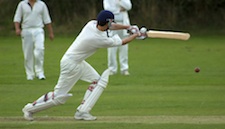
In addition to improving all-round strength, players also need to focus on critical areas such as the abdominal obliques and the shoulder girdle.
Before starting any match you should be sure to perform a thorough warm-up and stretching routine. Batsmen and bowlers should also perform appropriate dynamic movements - these will help to optimize performance and prevent
BATSMEN
Batsmen can potentially spend hours at the crease. This requires excellent concentration, good hand eye coordination, and the physical skills to make every shot count. A strong core and good upper body strength will allow you to play these powerful shots.
FIELDING
Fielders must have the stamina to remain in the field all day, plus the explosive skills to react when suddenly called into action. Keeping moving while in the field - walking, stretching - will allow you to suddenly burst into life and make a stop or catch.

BOWLERS
Bowlers need an explosive action combined with the endurance to keep going for over after over. Lack of fitness will reduce your effectiveness and increase the risk of injury.
The following is appropriate for all players:
CV TRAINING
You should perform a minimum of two CV sessions per week of 45 - 60 minutes. These should be at a moderate intensity (60 - 65% of maximum heart rate) - at this rate you should be working reasonably hard, but still able to hold a conversation. Options include running, cycling, rowing, stepper, etc. Combining several of these together into a workout is a good way to build up stamina, and helps reduce boredom.
SPEED WORK
Speed workouts stress the body, and should be performed no more than twice a week. Be sure to allow a few days to recover before a match.
The easiest form of speed work is shuttle runs - short runs of anywhere from 5 - 40 metres.
These will duplicate the runs you perform in a match. Practice not only standing starts, but also running starts and lying starts (as though you've dived for a ball and missed it). Initially perform these sprints in gym kit, then try them whilst wearing your pads and carrying your bat.
HAND EYE DRILLS
Throwing and catching drills are essential for developing the neuro-muscular system. Top teams practice these at all training sessions, and of course immediately prior to playing.
FOOT DRILLS
These are essential for improving foot speed. Typically these are practiced using a rope ladder, but if you don't have one available, you can mark out an area with chalk. Movements should be performed both forward and sideways to better duplicate playing conditions. The numbers indicate the order to run in.
1 |
2
|
3 |
4
|
5 |
6
|
Single leg run; aim to run on the ball of your foot, without catching the rope or chalk lines. |
1 |
2 |
3 |
4 |
5 |
6 |
Cross overs, Side step through the rope, taking your leading leg both in front and then behind the trailing leg. |
Most people move better on one side than the other. Work on your weak side to yield greater improvements in your game.
STRENGTH WORK
Strength training should always include a warm-up - ten minutes of CV will get your body ready to perform these exercises. Technique is crucial when performing any type of strength workout. Each rep, or repetition, has three phases - the concentric contraction (lifting the weight), the transition (where you pause for a second) and the eccentric contraction (lowering the weight).
Typically, the concentric phase comes first, although in exercises such as flyes and squats, the eccentric half comes first. The concentric contraction should take around two seconds, followed by a short pause, before the slower eccentric contraction, which should last around four seconds.
UPPER BODY
Work the upper body twice a week during the off season, once a week during the playing season. Using light weights will increase strength and stamina, not bulk.
 |
Single Arm Triceps Pullover. This exercise works the triceps muscle, which is crucial in both throwing the ball and batting. Supporting the working arm with your free hand, straighten your arm to lift the weight, keeping your elbow pointing upwards the whole time. Perform 3 sets of 12-15 reps with a lightweight. |
 |
Bench Flyes. These work your chest muscles. Flyes are performed on either an incline or flat bench, using dumbbells. Slowly lower the weights, remembering not to allow your elbows to go lower than your shoulders, then bring your hands back together at the top. Perform 3 sets of 12 -15 reps with a light weight.
|
|
Lateral Pull Downs work the muscles in your upper back. Pull the bar to the front of the body, then slowly resist as the weight pulls the bar back up. Keep your back straight and abdominals contracted to control any forward movement from your waist. Aim for 3-4 sets of 12-15 reps. These can also be performed seated on an exercise ball, which will force you to use your abdominal muscles more. |
|
Rear Deltoid Pull - this works the back of your shoulder. This exercise is performed using the lower pulley of a cable machine. Do 2-3 sets of 12-15 reps with a light weight. If one arm is weaker than the other, adjust the weight accordingly. If you feel your body twisting, you should lower the weight to maintain control. |
 |
Inclined bench Dumbbell Press - another exercise for the chest muscles. Perform 2-3 sets of 10 -12 reps using dumbbells. If you don't have access to an incline bench, or indeed appropriate dumbbells, you can substitute a flat bench and a barbell. |
  |
Standing Biceps - for the muscles in the front of the upper arm. Performed using either a cable or free weights, the key is to keep the elbows tucked into your side, and avoid swinging of the body. You can totally eliminate body sway by working with your back against a wall, but again, focus on keeping your elbows tucked into your sides.
When working with dumbbells, you can also perform a hammer curl, which is done with the thumbs upwards, rather than the palms of the hands. Perform 2 - 3 sets of 10 - 12 reps.
|
|
Reverse Flyes - these are an excellent exercise for the upper back and rear shoulder muscles. Rest your body on a bench to give support to your lower back.
Using a light weight, perform 3 sets of 15-20 reps, with a smooth, controlled action.
Avoid any jerking action during the movement. |
|
Cable Rotator - This will help strengthen the all important rotator cuff. Sit with your right side towards a low pulley. Hold the handle in your right hand, with your arm bent at 90 degrees, forearm parallel to the floor. Rotate your arm to bring the handle across your body, pause, then slowly return to the starting position. Be sure to keep your elbow tucked against your body the whole time. Aim for 2 sets of 10 - 12 reps. |
CORE STABILITY EXERCISES FOR YOUR OBLIQUE AND ABDOMINAL MUSCLES
Working your core muscles should be something that you do year round. See our section on core exercises for details.
LOWER BODY WORKOUT
Your lower body should be worked at least once a week, twice a week during the off season. See our section on lower body exercises for more details.
|  |
|