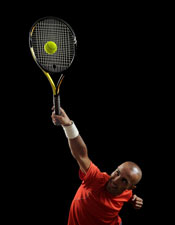
TRAINING
FOR RACQUET SPORTS
Being a sport that requires many physical requirements, such as good flexibility, co-ordination, aerobic fitness, strength and a good mental ability, there is obviously a lot of room for improvement in most players of any racket sport.
The main racket sports are Tennis, Squash,
Racquetball and Badminton. They are all similar in the fact that they require the same physical training.
-
Short bursts of explosive exercise, either
sprinting, jumping or swinging the racket.
-
Short recovery between each point, especially
for squash and badminton when played at a high standard. With tennis having
short rest breaks at various intervals of the game.
-
A lot of running around back and forth with
plenty of lateral movement to both sides.
-
Time on court can vary from 30 minutes to
3 hours plus, so a good endurance base is required for those that are serious
about their sport.
-
There is no rest period during intense rallies,
the rally stops when a player loses a point. Points are lost and won depending
on the skills and fitness level of you the player.
When you play you're chosen racket sport,
analysis each point you win and lose, with a number of different players
to find your strength and weaknesses. Work on improving all areas, however
start with the ones that you are weak on, in order to improve your game
quickly.
Break your results down into two groups:
-
-
Physical;
Your fitness level, flexibility, and strength.
-
Mental;
Co-ordination, skills, tactical abilities, and frame of mind.
Lets remember to get
fit to play sport, not play sport to get fit, this way, we will
enjoy the game more, and reduce the risk of injury.
Improving your physical fitness side is
straightforward; you need to improve your endurance by ideally a minimum
of 30 minutes cardiovascular activity at the right level 3 times a week.
Avoid doing your cardiovascular workout
before you play your game. Look in the Bodywork's section of the site under
Heart and Lungs for suitable exercises, and Aerobic training in the Fitness
section for guidelines on how hard to train.
Both weight training exercises and explosive
leg exercises such as short sprints and plyometrics can improve explosive
power. Remember to work within your own limits.
Aim to spend 1 day a week doing either
sprint / plyometric work. As these are both very demanding, avoid if you
have a low fitness level, or any injury.
For your sprint work, try and do the sprints
on the court you play on, wearing the same training shoes you play in.
There are many variations, however keep them short as for your sport.
Shuttle sprints,
from baseline to serving box and back, then up to the net and back. You
can repeat this with either no rest or short rest. For best results run
against a partner.
As above but sprint forward, and run backwards
coming back.
Ball retrieval,
place
a number of balls across the court, sprint to each one pick it up, return
it to the baseline, continue until all balls are recovered. Try
timing yourself.
Partner Ball Throw,
Stand
with your back towards the net or wall, with your eyes shut, have your
partner throw a ball in the air behind you somewhere. When they say "go",
aim to reach the ball as quickly as possible, you can also aim to hit the
ball over the net etc. with your racket.
North South East
West, Sprint North towards the net / wall, as you get half way,
side step East to the sideline / wall, then continue to sprint North. On
reaching the net / wall, run backwards to halfway mark, and side step West
to side line, then run back again to baseline. Take care when running backwards.
STRENGTH
TRAINING
The following exercises will help increase
your body strength, resulting in greater power. Aim to do these strength
/ aerobic training sessions if possible twice a week, especially in the off season. The members area will give you a full exercise description, plus a number of different workouts to gain all over body strength using both machine and free weights - speed and flexability to improve your game.
The key area for improving the power behind your serving and returning of the ball, will come from a strong core stabilty muscle mid-section. Our members area has over 200 different exercises for the abdominals, including a number of different workouts which are suitable for all fitness levels, using body weight - Swiss Balls and medicine balls - why not take a look and see how you and your game can benefit.
SESSION 1
LOWER BODY WORKOUT INTERMEDIATES 1 |
Use the following exercises to help strengthen and develop your lower body, aiming to perform each exercise correctly for 30 - 45 seconds, keeping good technique.
Rest for a minimum of 15 seconds prior to performing the next exercise. Once you have worked through all the exercises, walk around for 1 - 2 minutes, taking in some water, and then repeat the complete workout again.
Always warm - up and stretch prior to performing this circuit.
|
|
Date |
. |
Time |
. |
|
HIGH KNEE RUN CV |
WALL SQUAT
(HOLD FOR 30 SECONDS) |
STAR JUMPS CV |
FRONT / REAR LUNGE WALK |
. |
.. |
. |
|
|
PLIE LUNGE |
A / LEG SQUAT THRUSTS CV |
LYING ABDUCTORS |
LYING ADDUCTORS |
. |
.. |
. |
|
Aim to work through all 8 exercises - giving yourself enough rest between each exercise so that you can perform the next.
If your tired only work for 4 - 6 exercises.
|
WWW.NETFIT.CO.UK |
SESSION 2
|
UPPER BODY WORKOUT INTERMEDIATES 1 |
Use the following exercises to help strengthen and develop your upper body, aiming to perform each exercise correctly for 30 - 45 seconds, keeping good technique.
Rest for a minimum of 15 seconds prior to performing the next exercise. Once you have worked through all the exercises, walk around for 1 - 2 minutes, taking in some water, and then repeat the complete workout again for a further 30 - 45 seconds.
Always warm - up and stretch prior to performing this circuit.
|
|
Date |
. |
Time |
. |
|
PUNCHING
|
TRICEP DIPS
|
DORSAL RAISES |
3/4 PRESS UP |
.. |
|
. |
.. |
|
SUPERMANS |
WIDE ARM DIPS |
SPEEDBALL |
SWIMMING |
. |
.. |
. |
|
Aim to work through all 8 exercises - giving yourself enough rest between each exercise so that you can perform the next.
If your tired only work for 4 - 6 exercises.
|
WWW.NETFIT.CO.UK |
Along with these exercises, you should
aim to do the following at least twice a week, to aid prevention from tennis
elbow, and shoulder instability, which can occur due to the muscles in
your chest and front (deltoid) shoulder becoming stronger than those of
your back.
|
Aim to do the following WRIST exercises 2 - 3 times a week.
|
|
|
|
|
| Large rotations of a disk weight / heavy plate for 30 seconds in each direction. Keep the movement from the wrist.
|
Grasp a disk weight / heavy book between your fingers - holding for 30 seconds plus - keep weight close to the floor. |
Lift and lower a light bar or broom handle / golf club, using just the muscles of your wrist and forearm to do the lifting. Lift and lower under control 10/12 times. |
Hold a suitable bar or broomstick at arms length - smoothly cross over your hands towards the ends of the bar - keeping the bar horizontal. Aim for 5 moves in each way. |
|
Aim to do the following WRIST weight exercises 2 - 3 times a week.
|
|
|
|
|
|
Perform 2 sets of each exercise with suitable weight 12 / 15 times. Full exercise descriptions are available in the members area.
|
Stretching
As with most sports, people forget to stretch
prior to the start of the game. With all racquet sports having sudden bursts
at any point in the game, it is vital to stretch the whole body in order
to prevent injury. After a gradual warm-up spend time stretching, both
statically; (see the section on stretching in the fitness area of the Web
Site), then DYNAMICALLY.
Dynamic stretching involves slow
controlled rhythmic movements progressively through the range of movements
associated with your game. A section on dynamic stretching will be added
to the site.
At the end of your game, again spend a
few minutes stretching of your muscles. The members area has a complete section specifically designed for stretching for racket sports, along with a full explanation of over 1,000 different exercises and stretches.
Co - ordination
/ Skills
Eye - Body - Brain, is the way we
want to have our co-ordination and skills. Unfortunately many of us see
the ball, and our body takes too long to react to it passing us. This area
can be improved by developing what is called your motor skills,
so that you see the ball, and your body automatically positions itself
in the correct place.
With a complete variety of situations you
can be in for a ball to pass you, you need to work on improving your total
body, to react as one fast efficient machine.
Ladder Drills
Used to gain speed in footwork, lay out a rope ladder, or chalk out an area with approximately 15 inch squares. Combining ladders so that you go both forward and side ward's, will give you rapid results. The numbers indicate the order to run in.
1 |
2
|
3 |
4
|
5 |
6
|
Single leg run; aim to run on the ball of your foot, without catching the rope or chalk lines.
= Left foot = Right foot |
.. ... ... .. .....
1 |
2 |
3 |
4 |
5 |
6 |
Cross over's, Side step through the rope, taking your leading leg both in front and then behind the trailing leg. = Left foot = Right foot |
By performing these drills in both directions, you will soon realize that you are better on one side than the other. Aim to work on your weaker side for greater improvements in your game.
The following
drills with help improve hand / eye speed
-
Ball Drops:
Have a partner hold a ball in each hand, and get them to drop one of them
without warning in front of you. Your aim is to catch the ball before it
hits the floor.
-
Balloon & Foot:
Blow two balloons up, and spend time keeping them up in the air by either
hitting them with a racket, or kicking them with your feet.
-
Hand Changes:
Playing against a wall with a ball, constantly hit the wall changing hands
rapidly between shots, aim to get as close to the wall as possible.
-
Ball over Shoulder:
Looking straight ahead, have a partner drop a ball over your shoulder,
aim to hit the ball as quickly as possible either over the net or against
the wall.
-
Balance Ball Bounce:
If possible work on a wobble board, whilst a partner bounces balls towards
you. The aim is to rapidly change your position whilst being off balance.
-
Ball Play:
Working on your bad shots, have a partner constantly play against these
shots so that you can analysis what you are doing wrong.
Remember becoming fitter will certainly help
your chosen racquet sport, however good advice from a qualified coach,
or simply watching professionals play, will help improve both your tactical
ability and skills for the game.
A positive frame of mind is essential in
all sports, if you want to be a winner. Avoid getting negative, or simply
giving up the game, especially in Tennis. Work hard for every point, aim
to win every point, and watch the pressure you put on your opponent, when
you are 40 / 0 down but trying your hardest just to make it 40 / 15. It
is here that your opponent will start to get double faults, or simply get
frustrated with their game.
Remember that not everyone wants to win,
some people will play the game for the enjoyment, I hope that these notes
will improve your game, and enable you to play with players that are normally
of a higher level.
Serious about your fitness, there are currently over 1,500 different exercises with new training programs added each week within our members area.

© www.netfit.co.uk